Whether you’re rolling joints or packing bowls, a quality grinder can elevate your session from good to great, and help you make the most of your stash. A decent grinder has sharp teeth that slice and dice dry herb into a beautiful, fluffy mound.
Some even have mesh screens to sift out chunks and preserve the extra-potent pollen, AKA kief. And those with an integrated storage compartment will ensure that not a single gram is wasted. The dankness is in the details!
Here are our picks for the best weed grinders in 2022.
Cheech Glass wants to make the grind a little bit easier. (Courtesy Cheech Glass)
The 4-piece grinder from Cheech Glass makes fast work of even the stickiest herb, and features bevels along the top lid that make it easy to hold and twist for folks of all abilities.
It comes in a variety of colours and sizes, and boasts a “pop and lock” connection style, so you no longer have to worry about perfectly lining up your grinder’s inner threads. There is a replaceable thick-grit screen and a bevelled crystal tray for maximum trichome retention.
Hands full? The Tectonic9 grinder dispenses your weed at the push of a button. (Courtesy Tectonic9)
The Tectonic9 Manual Herb Grinder features an electric vibrating motor; with just the push of a button it dispenses ground flower into your bowl, paper, or vaporizer. Because you don’t have to worry about opening up the grinder to access the flower, it helps cut down on mess.
It’s made with a space-grade anodized aluminum body for durability. Its compact design is ideal for use at home or on the go, and it features a magnetic flip spout that allows you to accurately position your aim.
It’s got 50 teeth, a kief scraper, and a lifetime guarantee—what’s not to love? (Courtesy TITAN Crusher)
This grinder from TITAN boasts a durable aluminum construction with 50 diamond teeth that allow for effortless and efficient grinding. It’s available in a number of different colours and sizes for smokers of all walks.
The bevelled design makes it easy to hold and twist, while the strong closure ensures a quality seal that helps prevent spills. It comes with a free pollen scraper and cleaning brush to help keep your grinder in top condition. The company even offers a lifetime guarantee for any manufacturing defects.
This no-sweat grinder is perfect for stoners of every level and ability. (Courtesy Bananas Bros)
The OTTO grinder is a solid choice for newbies or those who struggle with mobility issues, as it grinds directly into a paper cone—no rolling skills required! Watching the cone fill with ground herb is even kind of mesmerizing.
It comes complete with organic paper cones that fit perfectly into the lower chamber for ease of use right out of the box. It’s battery-powered and charges via USB for use at home or while out and about.
You don’t have to spend a pretty penny to get a grinder with good teeth. (Courtesy Storz & Bickel)
Known for their vaporizers, Storz & Bickel also make a decent herb mill grinder at a highly budget-friendly price. This one suits those just getting started with cannabis, or looking to keep a spare grinder on hand without a major investment.
Its extra-sharp teeth produce finely ground flower, made from durable plastic, it boasts a lightweight design that is easy to clean. It can accommodate up to 3 grams of dried flower in a storage area under the clear cover.
The Canacrush grinder has four chambers to keep your bud and kief on lock. (Courtesy CanaCrush)
This grinder is another fairly budget-friendly option for those looking for a no-frills way to grind their stash. It is made of aircraft-grade anodized aluminum for impressive durability.
The 28 aluminum diamond-cut teeth and 24 grinding holes make it easy to process your favourite herb with ease. The lid stays in place thanks to a neodymium magnet that also helps to keep odour locked inside.
There’s an advanced micron mesh screen in the chamber to filter all that delicious kief – which you can gather with the included kief scraper.
Caitlin McCormack
Caitlin McCormack is a writer based in Toronto. Her work has appeared in MSN, Lift & Co., HuffPost, What to Expect, and Mashable, among others. When she isn’t writing, she’s busy chasing after her two sons, testing out new recipes, and working on her century-old fixer-upper.
By submitting this form, you will be subscribed to news and promotional emails from Leafly and you agree to Leafly’s Terms of Service and Privacy Policy. You can unsubscribe from Leafly email messages anytime.
A Siskiyou County, California district attorney announced on June 14 that four police officers will be cleared of charges after shooting and killing a man who drove a truck full of cannabis through a wildfire checkpoint.
But over the past year, witnesses and cops provided conflicting stories about what happened that day, which involved an Asian American worker.
In June last year, lightning ignited the devastating Lava Fire, and amid the chaos, things unraveled when they pulled over a man driving a truck with over 100 pounds of cannabis inside.
Officers were directing a line of vehicles leaving the area to escape the torrent of flames. Soobleej Kaub Hawj, 35, of Kansas City, Kansas, was driving a pickup truck that was loaded with 132 pounds of cannabis. He was most likely working for one of the many illegal greenhouses in the area. He also had firearms in the truck.
Police say that Hawj ignored orders to turn west onto County Road A-12, a main road at a checkpoint on June 24, 2021 as a fire ravaged a rural Big Springs area near the California-Oregon border, District Attorney Kirk Andrus said.
Officers say he panicked, fired a round at one of the officers, then they returned fire and shot him in the head, chest, arms, and legs. The police say they found a loaded .45 caliber Colt 1911 handgun on Hawj’s lap. Other assault rifles were found later.
However witnesses say over 60 shots were fired at the victim and that dash cam footage wasn’t released. The incident led to national outcry over suspicions about a possible anti-Asian American hate crime with the #StopAsianHate hashtag.
Officers attempted to clear their names. The Sacramento Bee reports that District Attorney Kirk Andrus sent out a nine-page letter Tuesday that outlined his findings to the officers’ supervisors at the Sheriff’s Office at the Etna Police Department and the California Department of Fish and Wildlife.
In his letter, Andrus said the point of the checkpoint wasn’t to find cannabis but simply to get people out of the area before it was engulfed by flames. Hawj, however, may have thought he would be stopped and searched, Andrus said.
“He had a cash crop in the back of his truck that he apparently was willing to defend,” Andrus wrote. “He may have had the misapprehension that residents were being funneled into an area where they would be searched for marijuana. He would have been wrong.”
Police say Hawj also had an arrest warrant in Mesa County, Colorado, on a cannabis and gun-related charge.
Siskiyou County already banned large-scale cannabis cultivation, but as of last year estimated there were 5,000 to 6,000 illegal greenhouses growing weed in the Big Springs area.
Locals in the Big Springs area say the farms typically involve immigrant workers of Hmong and Chinese descent. Because of the renewed focus due to the case of Hawj, The Daily Beast profiled “the embattled Hmong community in Northern California” that typically end up trimming or working in cannabis fields.
Not everyone was buying the police story, which is what led to the investigation in the first place. The Southeast Asia Resource Action center released a joint statement with Hmong Innovating Politics last August when the case was still fresh.
“One witness said over 60 shots were fired at Hawj during the incident,” the organizations wrote. “In response, Zurg Xiong held an 18 day hunger strike pushing for the release of body and dash camera footage from the shooting and an independent investigation from a different agency. On July 21, Oakland City Councilmember Sheng Thao, Elk Grove School Board Trustee Sean Yang, Sanger Unified Board President Brandon Vang, and Sacramento City Council Member Maiv Yaj Vaj sent a letter to California Attorney General Rob Bonta requesting an independent investigation into Hawj’s death.”
“The shooting is the result of escalating racial discrimination against the Hmong and Asian American community in Siskiyou County, CA. In 2016, multiple incidents of voter suppression against Hmong residents by the Siskiyou Sheriff’s Office were reported. More recently, the Siskiyou County Board of Supervisors enacted water ordinances targeted at Hmong and Asian American farmers while being aggressively and disproportionately enforced by the Sheriff’s Office.”
You can read the letter in its entirety to California Attorney General Rob Bonta. Also, check out the petition to support Soobleej Kaub Hawj’s family, which ended up receiving over 14,000 signatures.
For the time being, it appears the officers are off the hook and will not face any criminal charges in the matter.
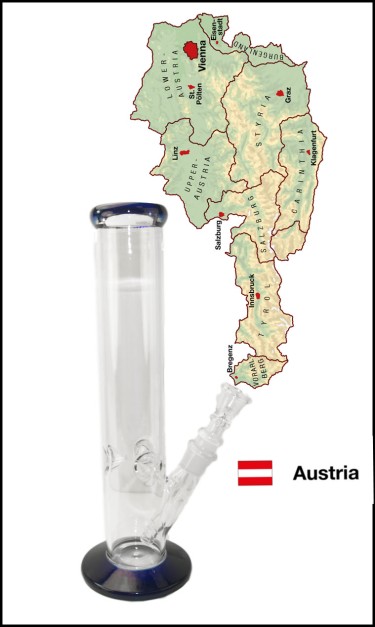
Presently, Austria is in a fascinating position as regards cannabis legalization. The third member of the European DACH alliance (a union that also consists of Switzerland and Germany) momentarily has no apparent legislative pathway to cannabis adult-use reform. This continues to be the situation even though its other trade partners are advocating for such debate in the European Union.
While that is the current situation, sales of dronabinol keep increasing every year in Austria even though it is not manufactured locally. The AGES (The Austrian Agency for Food and Health) cultivates medical cannabis flowers in hundreds of kilos annually which are exported to neighboring countries. Historically, a larger percentage is exported into Germany which is then refined into dronabinol and re-imported back to Austria.
As it stands, while the medical cannabis market in Austria is smaller when compared to that of Germany – limited cultivation with zero extraction – both countries do share some awful similarities. One of such similarities would be patients face several challenges regarding the procurement of insurance reimbursement. In Germany presently, the fastest and guaranteed approach is to sue, which considering the stockpile of legal cases, is merely another reason for further delay and gridlock.
Advocates in Austria are now looking to do away with all of this and be direct with recreational cannabis legalization even if not through Congress but by the legitimate challenge
The State of Cannabis Reform in Austria
The issues surrounding cannabis in Austria are quite complex given so many great areas regarding cannabis laws. Official adult use of cannabis is illegal in the country, but 30% to 40% of some young citizens between the age of 15 and 24 years have tried cannabis. As things stand herbal cannabis products are the most seized drugs across the. A country with hash holding the second position.
Among young citizens, medical use of cannabis is considered more acceptable compared to adult use. A survey carried out in 2017 discovered that 78% of young adults agreed with this bias. They believe medical marijuana should only be sold on doctor’s prescriptions and be made available only in pharmacies. Just a small percentage (29%) supported that marijuana is made available to adults aged 21 years and above.
The same survey also indicated that even though cannabis is used for medical purposes, a larger percentage of Austrians want it to be tightly regulated. Only a small percentage of 26% approved that everyone should be able to cultivate cannabis for medical use. 20% remained unsure and 53% disagreed. Just about 21% approved that medical cannabis is made available at hemp shops and drug stores for purchase without a doctor’s prescription while 59% were against it. In summary, while the Austrian government do not plan to enact more stringent restrictions, support for less stringent laws does not seem popular among Austrians.
Cannabis reform in Austria still has a long way to go. At the moment, it is illegal for citizens to sell, buy, consume, or cultivate cannabis (except the plant is not allowed to bloom). However, possession of cannabis flowers in small quantities has been decriminalized since 2016.
Nonetheless, like every other country that has continuously stalled on cannabis reform, the case continues to progress in the court.
The Supreme Court Challenge May Change the Game
Things might soon change for recreational cannabis reform in Austria. Right now, a conceivable deal-breaking case is now pending at the Constitutional Court in the country. The court is presently assessing a private petition issued by a 26-year-old named Paul Burger.
In 2020, Burger, in possession of a half-burned joint, was arrested by two undercover cops in Vienna. Now, together with a renowned lawyer, Dr. Helmut Graupner, he had a good chance to win the cases. Dr. Helumt Graupner is also known to have previously challenged the ban on same-sex marriage in the country, a case which he won. So, many advocates are hoping he succeeds in this one too.
With Burger’s petition, the highest court in Austria must now examine if the Narcotics Drugs Act in Austria is constitutional. The argument brought forward which is similar to that before the Supreme Court in Mexico is that private cannabis use does not endanger others.
Hence, the right to self-determination and privacy should protect cannabis use that doesn’t harm others. This same argument is also very similar to the idea responsible for the legalization of assisted suicide which was enacted earlier this year in Austria.
The Black Sheep or Potential Market Leader?
The legality of private use, cultivation, and possession of cannabis is an issue that has hovered across the legalization debate in Europe. Although, the debate is not as direct compared to the context of North America ( You can check both Mexico and Canada. Just last year, Albert Tio put up a legal challenge in Spain as regards access discussion when it was brought to the clubs. But unfortunately, the European Court of Human Rights rejected the legal challenge.
In the German context, before 2017, patients’ legal challenges became the game-changer for cannabis legalization. But, as patients began to count on their wins on the legal front, the Bundestag enacted new statutes. For instance, one of the laws demanded that patients must not cultivate their cannabis. Rather, they should obtain it through a pharmacy based on a doctor’s prescription. Furthermore, the law compelled that provided the patient’s condition could not be cared for with other medications, insurers were expected to reimburse.
As it stands, the model has greatly failed which is why the German government is now back in the process of enacting legalization measures before the year ends.
Conclusion
Considering decisions on the Austrian case are to be made around the same time, this could set a precedent in the German-speaking region of Austria. Ultimately, this could formalize adult-use cannabis reform across Europe and not only in the DACH countries.
United Arab Emirates Attorney General Reduces Drug Penalties
Being caught with marijuana or other drugs, even alcohol, while in the United Arab Emirates can lead to long jail sentences.
Now, things may change as the Attorney General has just given local courts the ability to treat more illegal crimes with fines instead of jail. Dr. Hamad Saif Al Shamsi, AG, has listed 13 offenses now punishable by fine including crimes for getting caught with products with CBD or cannabis; in this case, these products would already be confiscated instead of people facing the risk of going to jail, reports The National News.
In addition, people who have been caught with drugs face penalties ranging from USD $2,720 to $8,170 for first offenses, which will significantly increase for the second and third offense. However, those caught for drug smuggling can still face 5 years and a death sentence if prosecutors choose to pursue them.
Dr. Al Shamsi explains that it’s the prosecutor’s goal to “rapidly resolve lawsuits and provide innovative, judicial and legal services, which are in line with global trends, meet the needs of the community,” he said in a statement. “The new anti-drug law considers the fact that some users are patients and victims of drug dealers,” he said.
Malaysia Discusses Developing Medical Marijuana Industry, Ends Death Sentence
Last April, the Medical Cannabis Caucus (MCC) of Malaysia met with the Prime Minister, Datuk Seri Ismail Sabri Yaakob to confer on policy issues related to medical cannabis, hemp, and ketum in Malaysia. They released a statement acknowledging the Prime Minister’s positive feedback regarding the issues in question.
“This is an industry that is being actively developed by many foreign countries. More than 40 countries have already allowed the use of cannabis for medicine. The market value of this industry has reached RM 60 billion. In fact, neighboring countries like Thailand are also studying this industry for their country,” said the Malaysian cabinet in a statement, reports The Straits Times. “The Prime Minister responded positively on issues concerning the industry and said the matter will be discussed in further detail by the Cabinet.”
“The MCC believes that Malaysia has great potential and opportunity in this industry for medical purposes and research, and is able to provide great benefits to this country,” the statement said. “Legal views were also the main concern during the official meeting just now. The MCC thanks the Prime Minister for attending the meeting.”
A recent survey revealed that decriminalization of medical marijuana is favored by a great deal of Malaysians.
The Malaysian Cabinet has also just decided to end the mandatory death penalty, which made the Asian country notorious for having some of the harshest drug laws in the world, reports High Times. The death penalty was removed for 12 crimes including non-violent drug crimes, which was a “welcome step in the right direction,” said Amnesty International. It could be that medical marijuana reform has been the primary cause for reform, given the government’s keen interest in medical marijuana.
Ukraine-Russia War Prompts Medical Cannabis Legalization
The Ukrainian government is working to legalize medical marijuana.
Part of the decision has been brought about due to the trauma caused by the war started by Russia, reports NPR. Last Tuesday, Minister of Healthcare Viktor Liashko stated on Facebook that the cabinet had just approved a law “on regulating the circulation of cannabis plants for medical, industrial purposes, scientific and scientific-technical activities to create the conditions for expanding the access of patients to the necessary treatment of cancer and post-traumatic stress disorder resulting from the war.”
The drafted bill is on its way to the Ukrainian parliament, though a minimum of 226 votes are needed for its approval.
Germany Prepares To Legalize Production And Sale Of Recreational Marijuana
Germany’s Health Ministry is now getting ready to legalize recreational cannabis, starting with expert discussions on the topic, reports US News. According to them, over 200 experts from the legal and medical field as well as others will be partaking in the talks with government officials.
In 2021, a coalition deal among the 3 social liberal parties under Chancellor Olaf Scholz pledged to legalize regulated recreational cannabis sales within licensed marijuana shops as part of drug reforms. Five hearings are expected to take place throughout June 2022 to establish what needs to be put in place for recreational cannabis to be legalized while ensuring that the youth are protected. Other agendas include consumer protection, health, supply chains, criminal liability, international experience, licensing, control measures, and economic issues among others.
“Like many others, I have worked for years toward us in Germany finally ending the criminalization of cannabis consumers and beginning a modern and health-oriented cannabis policy,” said Burkhard Blienert, designated drug czar, in a statement.
“The hearings are intended to discuss which measures can be used to ensure the best protection for young people, health, and consumers in the event of implementation,” he adds. “Because one thing is clear: we want to protect children and young people in particular from possible risks,” he said.
Morocco Looks To Regulate Legal Marijuana
Morocco, the number producer of cannabis resin in the world, adopted laws last year that would authorize the legal use of cannabis for medical, industrial, and cosmetic purposes. Part of the plans to do so involved creating a national regulatory agency that met for the first time early in June to discuss the next steps involved.
The National Agency for the Regulation of Cannabis Activities (ANRAC) finalized their 2022 budget and organizational chart during the meeting, reports Africa News. Moving forward, ANRAC will be tasked with overseeing all phases of marijuana production including seed importation to cannabis product marketing. Meanwhile, they will soon be launching the licensing process needed for international as well as local operators in the cannabis industry.
However, the use of recreational cannabis is still illegal in Morocco. This hasn’t deterred tourists from attempting to score what is considered among the world’s best quality hashish and resin though if caught, they are often let off with a fine.
THE CANNABIS NEWS FROM AROUND THE WORLD, READ MORE..
A gram, an eighth, an ounce—what does it all mean? We’ve come a long way from the “dimebag” and “twenty-sack” days, but the legal cannabis industry’s interchangeable use of the metric and imperial measurement systems gets confusing fast; who hasn’t mixed up their weed amounts at one point? Keeping track of all the names associated with different cannabis quantities sold in dispensaries, delivery services, and from a guy (wink, wink) can be challenging, and at worst, a rip off.
Central to the confusion is our conceptualization of weight versus mass, which depends on both product size and density. If you are new to cannabis, this video and written visual guide will provide you with a general framework to wrap your head around the common sale quantities for flower so you don’t get stiffed.
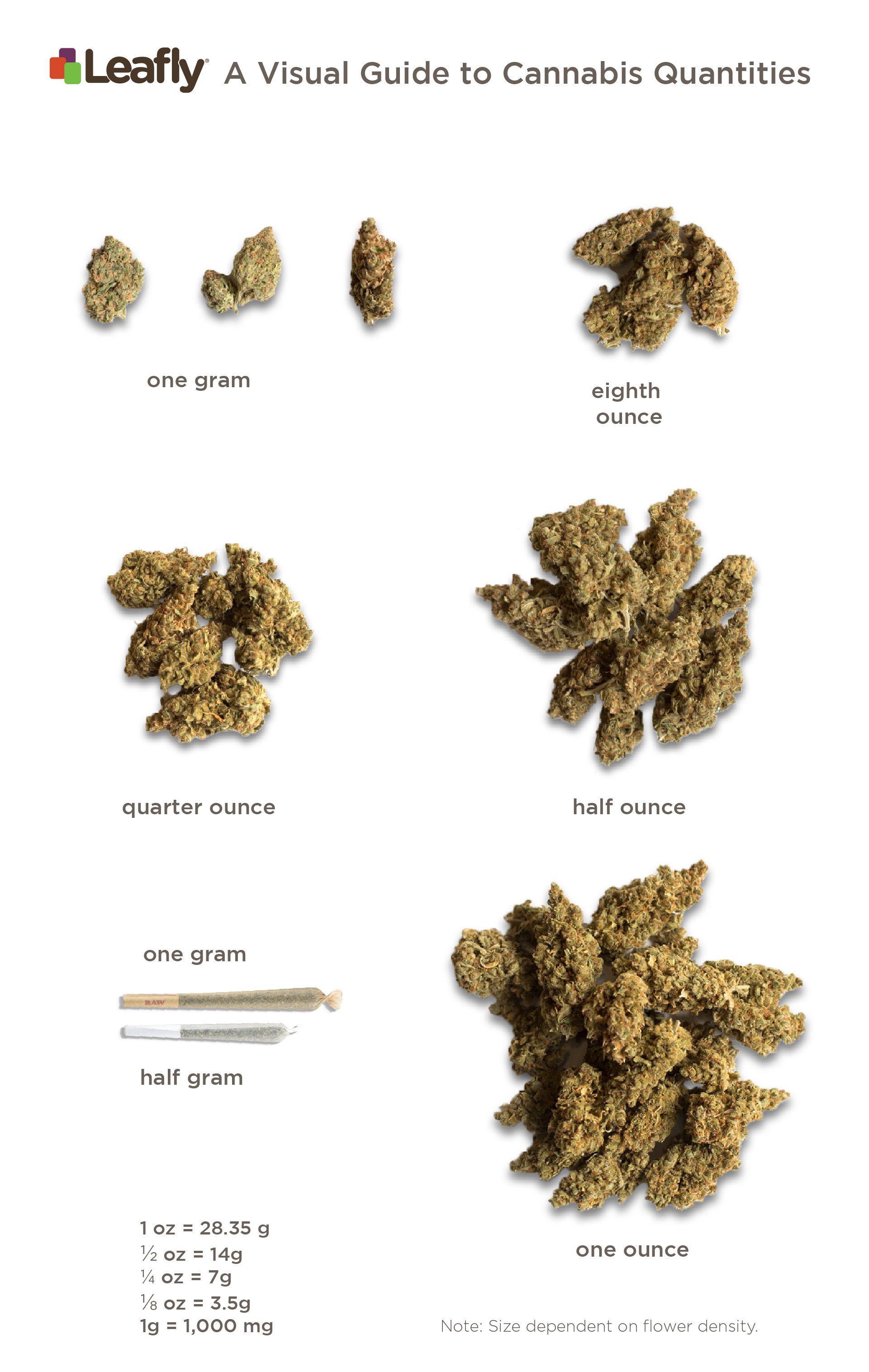
What do standard amounts of weed look like?
If grown well, 1 gram of cannabis flower comes out to about one medium-to-large-sized bud, or two smaller budlets. An eighth is usually made up of a handful of two to four buds, depending on stem size and how tightly the buds are packed; many operators save the biggest and prettiest nugs for their eighths. A quarter ounce will vary in volume depending on if it’s made up of smalls or hearty buds, but should easily fit in a sunglasses case.
As the quantities get larger, they get harder to predict in terms of size, but a half ounce to a full ounce of weed is enough to fill a standard resealable sandwich bag.
Click to enlarge. (Elysse Feigenblatt/Leafly)
Related
The curious case of the stolen bike and the missing quarter-ounce
Something to note: these depictions are only informed approximations, given that density varies (at times drastically) between plants, strains, and brands. Indica strains tend to grow as stockier plants with thicker, denser buds, whereas sativas tend to have longer, more stretched nugs. Think of it like the riddle of a pound of feathers versus a pound of gold; a dense cannabis flower from the Cookies strain family can look a lot smaller than a fluffy bud of Jack Herrer, despite both weighing the same.
Thankfully, cannabis companies and producers must determine the exact weight of your weed before it gets packaged and brought to a distributor to be sold; even if it doesn’t look like an eighth in the jar or bag, the scales don’t lie.
It’s also important to remember that the weight of cannabis buds is not purely from the smokable parts of the plant. Some of the weight will come from stems and moisture levels. Cannabis flower will lose weight as it ages and dries out, so always check the package date when buying in-store.
A gram of cannabis flower is going to look a lot different than a gram of concentrates or cartridge oil. We recommend asking your budtender for specific questions about dab and non-flower quantities.
Related
Indica vs. sativa: understanding the differences between weed types
How to convert ounces of weed to grams
Before the regulations that came with recreational weed legalization, you probably remember buying weed in fractions, depending on your needs; some weeks might have called for an “eighth” (⅛ ounce), and others a “quarter” (¼ ounce). But at the dispensary, you’re far more likely to see buds packaged in gram amounts. For reference, here is a quick conversion guide from ounces of weed into grams.
Imperial amount
Metric amount
Eighth (1/8) ounce
3.5 grams
Quarter (1/4) ounce
7 grams
Half (1/2) ounce
17 grams
Full (1) ounce
28 grams
Full pound (16 oz)
448 grams
The price of flower depends on the quality of the product, the market (medical or adult-use), and the tax structures in the state and county in which it is sold. You can expect to pay between $10 and $20 for a gram of flower and $25 to as much as $75 for an eighth. Some companies offer bulk discounts and dispensaries often run deals to help with the sticker shock.
Express Summary: Ounces vs grams of weed
Under adult-use regulations, the most a customer can purchase from a dispensary or delivery service in a day is one full ounce of flower. Medical marijuana programs may allow more, but most people hardly ever reach their purchasing limits.
The smallest amount of cannabis flower you can buy from a licensed retailer is one gram. A gram is going to roll about two personal-sized joints or about three to four bowls in a pipe or bong, making it a great option for the occasional consumer and when trying a new strain. Next size up, and by far the most popular amount, is three and a half grams, or an eighth. That’s enough for about seven joints; seven grams (a quarter ounce) will get you about 14 joints, so 14 grams (or a half ounce) can roll nearly 30 joints. Thus, a full ounce of cannabis, which is 28 grams, can roll nearly 60 joints or pack upwards of 100 bowls.
Keep in mind that pre-rolled joints are often sold in half gram or full gram quantities. You may choose a half gram to share with a friend or a full gram for a larger group.
Related
How Many of These DEA ‘Cannabis Slang’ Terms Do You Know?
Slang terms for weed measurements
While dispensaries across legal and medical states have standardized their measurements and made a clear system for purchasing the legally-allowed amount of cannabis, for most of history people were buying weed based on visuals and what they could afford. This is where the code words come in. Even if you never intend to use them, stoners have always innovated the language pertaining to their most prized purchase. Here are some choice slang terms for weed measurements, in ascending order:
A “g,” a gerb, a deag: a gram
A nickel bag: $5 worth of weed. This is typically half a gram to 1 gram, depending on your dealer’s generosity.
A dimebag, dime, or dime sack: this is $10 worth of weed. While amounts vary by dealer, this is typically half to 1 gram.
Twenty-bag, dub sack, or just a dub: this is $20 worth of weed. Amounts also vary, but hopefully you’re getting at least a gram to 1.5 grams.
A sixteenth, half-eighth: this is half an eighth, which is roughly 1.75 grams.
A slice: just as a pizza slice is one eighth of the pie, a “slice” is one eighth of an ounce.
A half-zip: this is a half ounce, or 14 grams.
A zip: this is an ounce of weed (28 grams), named for when they were handled in resealable plastic bags pre-legalization.
A “qp” (pronounced as cue-pee): a quarter-pound of weed, or 4 oz.
A pack: this is a pound of weed, named for how they’re transported in turkey bags.
How to make sure you’re getting what you paid for
Before states implemented adult use legislation that included track and trace monitoring of all cannabis and derived products, many dispensaries operated deli style, allowing patients to customize the amounts of weed they wanted based on budget within view of the scales. Now that flower must be pre-weighed and packaged before reaching the consumer, you may harbor doubts that you’re getting your money’s worth.
If you’re worried about getting jilted, we highly recommend investing in a scale. Once home, weigh out your weed and compare it to the amount listed on the packaging. If there’s a discrepancy, we encourage you to bring it back to your dispensary or contact the delivery service, with photographic evidence. Most companies have no qualms about replacing underweight product.
This post was originally published on November 18, 2014. It was most recently updated on June 14, 2022.
Leafly Staff
Leafly is the world’s largest cannabis information resource, empowering people in legal cannabis markets to learn about the right products for their lifestyle and wellness needs. Our team of cannabis professionals collectively share years of experience in all corners of the market, from growing and retail, to science and medicine, to data and technology.
By submitting this form, you will be subscribed to news and promotional emails from Leafly and you agree to Leafly’s Terms of Service and Privacy Policy. You can unsubscribe from Leafly email messages anytime.