After four years of exhaustive efforts, California leaders eliminated the cultivation tax along with other changes, providing some bit of respite for cultivators. But does the plan just move money around, and is it even close to enough to save struggling farmers?
California Governor Gavin Newsom released his 2022-2023 revised budget on May 13—most notably containing the much-needed tax cuts. On June 29, Assembly Bill No. 195 passed in the Senate by 34-0, and the California Assembly voted 66-0 in favor of the bill. The bill took effect immediately following the signature of Newsom, providing the legal cannabis industry some much-needed temporary tax relief, which began July 1.
The state’s cultivation tax at over $161 per pound was scrapped and money was reallocated: Cannabis excise rate will remain at 15% for three fiscal years—but may be increased after July 1, 2025. Equity licensees will be able to retain 20% of the excise taxes they collect to reinvest into their businesses. They will also be eligible for a $10,000 tax credit. It also includes $40 million in tax credits, of which $20 million will go towards tax credits for storefront retail and microbusinesses, and $20 million for cannabis equity operators. The bill allows qualified businesses to claim tax credits of up to $250,000 for qualified expenditures beginning in the 2023 taxable year. It also adds additional enforcement tools against the illicit cannabis market.
Hardly a Long-Term Solution
Doug Chloupek, CEO and founder of Juva Life, faced many of these tax woes as a manufacturing permit holder in California. When Newsom proposed his revised budget back in May, Chloupek said the cannabis cultivation tax cuts failed to fix several key problems. Keep an eye on those excise tax rates in the next three years, for instance.
“It’s slightly better than a three-card shuffle and a nice little pretty Band-Aid on its surface,” Chloupek tells High Times. “Those who are entrenched in the industry would think, ‘Wow, this is an amazing thing.’ But at the end of the day, it’s more generally a bandaid to stop the inevitable bleeding that can only be fixed by the elimination of IRS Tax Code 280E—which is systemic to federal issues, and leaving it to a state like California, which has some of the highest taxation on a commodity that’s lost 80% of its value is just intrinsically the wrong move for our industry as a whole.”
In recent years, California’s price per pound of cannabis plummeted, and some growers faced what Johnny Casali from Huckleberry Farms described as “an extinction event.” A pound of cannabis—once worth up to $1,500 or more for some farmers—plummeted as low as $300 per pound. And when you shave off the $161+ per pound cultivation tax, that gobbles up half its value. Part of this price drop has been blamed on the advent of light deprivation weed.
“A good portion of the cultivation tax—which was being passed down by distributor to distributor to distributor and lost in the supply chain,” Chloupek says. “So it was never being paid anyway. So in terms of a cultivator materializing, an extra $160 a pound in value to help bridge the gap of the intrinsically broken system that we fundamentally have. At its core, it’s going to do nothing to help us cultivators that are dropping like flies right now.”
Chloupek’s 12-year background in the legal market began when he says he became the first permit holder in the state of California for cannabis manufacturing. Juva Life received a license to operate a storefront in Redwood City, where during the application process Juva was the highest-scoring applicant. The retail store is already under construction, and planned to open in Q3. Juva Life is focusing on cannabis research to create longevity for their business, and recently closed $11.8 million in funding.
What Businesses Say
“It’s a fundamentally broken problem,” Chloupek adds. “And they’re just looking at the industry as a cash cow, which is designed to fail, which is following the repetitive steps of every big transitional industry from big AG and Monsanto to a handful of them that have their monopoly to alcohol, tobacco, to form a they it’s a it’s a control consolidation is what you’re seeing right now. And by squeezing the industry at such a point by design or by unintentional or by thinking, all that’s doing is [hurting the people] who built it for the last 30 years, and who are being squeezed out of the industry. And unless you’re an MSO with a half a billion dollar market cap with, you know—$100 million in the bank to weather the next two years of storm, or you’re vertically integrated and you can barely squeak by your chances of surviving the next 2 to 3 years are next to nil.”
Members of the California Cannabis Industry Association seemed to agree that more steps are needed if the state is actually going to save the cannabis industry.
“The survival of the regulated industry is vital to providing ongoing tax revenues for the State and the advancement of public health and safety. Eliminating the cultivation tax is just one step towards stabilizing our industry but it’s an important one,” relays Lindsay Robinson, CCIA Executive Director.
Others say the legislation doesn’t go far enough regarding social equity measures.
“CCIA has worked for the past four years to eliminate the cultivation tax and we’re extremely proud of this important first step,” Robinson added. “Stability of the cannabis supply chain brings jobs and much needed tax revenue to the state while also protecting public health and safety and keeping cannabis out of the hands of children.”
While dropping the cultivation tax was a step in the right direction, it’s hardly a fix for an industry that is still fundamentally flawed.
Folks, the numbers are in, and sheesh, you guys really went for it this Independence Day weekend.
Thanks to data provided by a handful of cannabis analytics and marketing companies including Headset, Flowhub, and Lantern, we have some bold insights into the power of July 4 to compel you, America’s Fans of The Plant, to buy weed. A lot of weed.
Read on to learn more about the types of products folks bought, when sales peaked, and how the holiday weekend compared to other times of the year.
Only 4/20 racked up more sales than July 1
We all know that 4/20 is the Holy Grail, the biggest day for cannabis sales in America. But, at least so far in 2022, July 1st gets to take home the silver medal.
According to data provided by Flowhub, on July 1st—which fell on a Friday—sales climbed 15% higher than an average Friday.
This data suggests that cannabis consumers wanted to stock up for the weekend on July 1, and then get their party on without having to head back to the store. Respect.
Sales remained strong over the weekend on July 2 and 3—just a couple of percentage points over average weekend sales—and then they dropped a tiny bit below average Monday sales figures on the holiday itself.
Related
Leafly’s 100 best cannabis strains of all time
Pre-rolls had a moment over the holiday weekend
It’s no surprise that consumers leaned into the Holy Trinity—flower, edibles, and vapes—over the holiday weekend.
But Headset reports that pre-rolls saw a 6% increase on July 4, specifically.
The home delivery platform Lantern presented similar data, and pointed out that cannabis beverages also got more love than usual.
Related
On the grind: Best weed grinders for bowls and blunts
Canada Day didn’t fare quite as well
While Americans proved ready to open their wallets for Independence Day, our neighbors to the north didn’t exactly turn out the same way for the national holiday of Canada Day, on July 1.
According to Headset, sales on the holiday itself dipped 23% below the average of the previous four Fridays.
Residents of Ontario really didn’t feel like shopping: sales dropped 29% on the holiday.
I guess the Canadians just prefer to celebrate their national holidays in a different style, eh?
Max Savage Levenson
Max Savage Levenson likely has the lowest cannabis tolerance of any writer on the cannabis beat. He also writes about music for Pitchfork, Bandcamp and other bespectacled folk. He co-hosts The Hash podcast. His dream interview is Tyler the Creator.
By submitting this form, you will be subscribed to news and promotional emails from Leafly and you agree to Leafly’s Terms of Service and Privacy Policy. You can unsubscribe from Leafly email messages anytime.
A group that is aiming to legalize medical cannabis in Nebraska submitted ballot petitions just under the wire on Thursday, ending a campaign that has been beset by tragedy and financial hurdles.
Nebraskans for Medical Marijuana said that it had turned in thousands of signatures to the secretary of state in the hopes of getting the medical cannabis proposal on the Cornhusker State ballot this November.
The group will now await word to see if the measure will qualify for the ballot.
“It’s official, we turned in 184,000+ signatures to put medical cannabis on the ballot,” said state Sen. Anna Wishart, a Democratic lawmaker who co-sponsored Nebraskans for Medical Marijuana. “We will know in the coming months if it was enough to qualify. Every signature represents a person who had the guts to go out and ask and a person who had the heart to sign. Thank you Nebraska.”
Nebraskans for Medical Marijuana has dealt with a series of setbacks throughout its petition drive. In March, the group’s outlook appeared dire after one of its top donors died in a plane crash, and another donor had been diagnosed with terminal cancer.
“I’d say devastating is an understatement,” said Crista Eggers, who also led the group’s petition campaign. “We’re pleading with you to help.”
“If what we needed was grit, and drive, and determination, we have that,” Eggers said. “Our campaign would be done and over if that’s what we needed. But unfortunately, the one thing our campaign doesn’t have – and has to have – is money.”
Eggers’ motivations are personal: her son, Colton, has epilepsy and is unable to receive medical cannabis treatment in Nebraska.
“We’ve received so much encouragement from individuals all across the state, who support the many patients like our son Colton, who desperately need access to this medicine. No matter what your political background is, we should all agree that criminalizing a medicine that has the potential to alleviate suffering, is both cruel and inhumane,” Eggers said in announcing the group’s petition campaign last fall. “The current policy doesn’t reflect our family values here in Nebraska, and we’re going to change that. We need everyone who believes in compassion for suffering individuals like my son to be part of this movement and help us win in 2022.”
On Thursday, Eggers marveled at the group’s resilience.
“These were people that cared about this issue and they continued stepping up you know one day after another and when things got tough, right, they kept going,” Eggers said, as quoted by local television station KETV.
“There was no choice to give up, right. Because of all of you. Because of all the people, the stories, who were relying on us to get this done,” Eggers added.
Nebraskans for Medical Marijuana turned in the signatures at the 11th hour, befitting the tumult that defined its petition drive. KETV reported that the group “used every second they could before they had to turn in their signed petitions in Lincoln,” with people “still signing the petition outside the Secretary of State’s Office less than an hour before the deadline.”
In a post to its Facebook page on Thursday afternoon, the group urged both individuals who wished to sign the petition and notaries to come to the secretary of state’s office.
Nebraskans for Medical Marijuana mounted a previous effort to get a proposal on the state ballot in 2020, but the Nebraska Supreme Court ruled it ineligible.
“As for what happens tomorrow, we’ll face that tomorrow,” Eggers said on Thursday, as quoted by KETV.
These tasty, friendly treats are the face of hemp edibles.
Get 50% off all gummies from The Hemp Doctor with code LEAFLY50.
In the olden days of cannabis, most people consumed it by just buying a bag of flower and smoking it—or, if they were feeling fancy, perhaps baking it into a brownie or cookie full of cannabis flavor. But the changing face of cannabis means a shift in demographics. With hemp-based products, whether they contain delta-8 THC, delta-9 THC, CBD, or other cannabinoids, gummies and other discreet edibles reign supreme.
What’s responsible for this shifting tide? First of all, making everything above-board has increased recreational cannabis and hemp producers’ options considerably, especially in the hemp world. The Agriculture Improvement Act of 2018, better known as the 2018 Farm Bill, legalized the production of hemp as long as the end product has less than 0.3% delta-9 THC by dry weight.
Making hemp federally legal meant cannabis pros could open labs and state-of-the-art facilities, then collaborate and share knowledge with others across the country. Hemp producers have even started offering something that previously only recreational markets could—noticeable levels of traditional, delta-9 THC.
Related
Delta-9 THC from hemp is legal nationwide. Here’s why and how to find it.
All these new capabilities allow hemp pros to make tastier, more convenient treats than ever before for both seasoned and beginner consumers alike—everybody loves gummies—and it gives the newbies some unintimidating options. On a more scientific level, being able to deal with isolated elements of the hemp plant means that producers can achieve much more accurate dosing, and even fine-tune specific blends of terpenes and cannabinoids.
“Gummies really helped to destigmatize cannabis,” notes Robert Shade, owner of education-forward cannabis brand, The Hemp Doctor. “My dad’s 87 years old, and he’s finally accepted that THC and weed aren’t that bad.”
Familiar experience
Courtesy of The Hemp Doctor
For those who got their first exposure to cannabis through after-school specials, smoking, tasting, or even vaping cannabis can be off-putting. It calls to mind outdated stereotypes about drug use that are hard to shake and can make many people nervous, even if they want to try THC. Gummies, along with a whole new generation of edibles, offer a variety of familiar, approachable options, allowing those new to cannabis or coming back from a very long break to choose what works for them. These options are so effective, says Shade, because they’re easy to use and people “can choose their own options as opposed to having to smoke something.”
Unprecedented accuracy
It’s not just the form and flavor that’s user-friendly. Modern gummies typically provide a straightforward, consistent experience, so it’s harder to accidentally overdo or underdo it—a common pitfall with old-school homemade baked goods.
To ensure ultra-accurate, predictable dosing, trustworthy producers check potency at multiple points throughout the process. The Hemp Doctor starts right at the beginning of the process by testing individual distillates before sending them off to manufacturers. When they come back, they test again.
Related
Pot quiz: Do you know delta-8?
“We don’t rely on the manufacturers to provide those reports; we source those reports ourselves,” explains Shade. “It’s important in the cannabis arena regardless of what you’re making, whether it’s a gummy bear or a vape cart.”
With reliable lab results, producers can get the same THC and CBD levels each time, avoiding surprises for customers. This accurate record also allows them to make specific blends of terpenes and minor cannabinoids. It’s a scientific concept known as the “entourage effect,” which means that elements of cannabis, when put together, can create unique effects that they couldn’t have on their own. When you know exactly what you’re putting in there, it’s much easier to tease out the effects of each blend to create, for example, a gummy that’s especially helpful for those with insomnia or one with just the right amount of daytime vigor.
Courtesy of The Hemp Doctor
“We’ve really believed from the onset that it’s not just CBD and it’s not just THC,” says Shade. “There’s CBG, CBN, and there’s CBC, just to name a few. There’s a whole multitude of cannabinoids that we continue to educate ourselves on.
Related
How to take THC-O—the right way
“We recognized pretty quickly these various cannabinoids played a big role in cannabis’s impact on people,” he adds. “From that point, we just took it to say, ‘what’s the safest, and most effective way to blend it?’”
Variety for everybody
In the past, edible flavor options were essentially limited to weed or the slightly-more-subtle chocolate weed. Those days are long gone now, and nothing showcases the edible’s renaissance quite like the humble gummy. The flavor options are nearly infinite, with a selection that rivals the gummies in the actual candy aisle.
They’re also easy to adjust to dietary needs like vegan, keto, or gluten-free—and with so many options available, you can find pretty much any cannabis edible, whether it’s a gummy, cookie, or savory snack, that meets your needs in brain, body, and taste buds.
Choosing the right gummies
Courtesy of The Hemp Doctor
Just because producers can make higher-quality goods doesn’t mean they actually do, and some even get lazy enough to just spray isolates on top of gummies instead of infusing them. The Hemp Doctor does it right by blending their formula of isolates/distillates together, then mixing it right into the gummy product before they’re molded. They also publish third-party certificates of analysis, or verified lab results, for each product, a must-have from trustworthy brands.
This small selection of gummies meets not only The Hemp Doctor’s strict quality standards, but a variety of preferences for potency, effects, and flavors, giving some idea of how versatile gummies can be.
D-9 Downshift: These gummies have a mixed-fruit flavor and a subtle-yet-euphoric effect from a blend of 7.5mg delta-9 THC and 1mg each of CBC, CBG, and CBN.
D-8 Gummy Worms: Feeling like putting the “trip” in “trip down memory lane”? Each of these sweet-and-sour gummy worms has a full 30mg of delta-8 THC with only trace amounts of other cannabinoids.
Delta-9 THC/CBD/CBN Nighttime Gummies: Each of these potent gummies has 12.5mg of delta-9 THC, enough to feel its effects, along with 15mg of CBD and 5mg of CBN for the perfect evening wind-down.
Delta-8 Vegan Gummy: These gummies pack the same potency as the Delta-8 Gummy Worms—that’s 30mg a pop—into a vegan, pectin-based treat that comes in a rotating selection of tasty flavors like watermelon, mango, and lemon.
Courtesy of The Hemp Doctor
Delta-9 THC/CBD Full Spectrum Gummy: Another vegan option, these low-key treats each have 12.5mg of delta-9 THC and 15mg of CBD and come in tangerine, watermelon, and elderberry flavors.
Delta-9 Vegan Gummy: These vegan gummies each contain 25mg of premium delta-9 THC with 10 pieces per bag. Find them in blue raspberry, cherry, grape, green apple, pineapple, and watermelon.
Go forth and get your gummy on with these recommendations and a vast world of federally legal hemp-based options for fans of recreational hemp. The Hemp Doctor supplies high-quality, lab-tested cannabinoid products in a huge spectrum of formats, so start your search with them and see what new favorites you discover.
Leafly novel cannabinoid disclaimer:
Use and possession may be restricted by law. This product may expose you to harmful chemical byproducts.
By submitting this form, you will be subscribed to news and promotional emails from Leafly and you agree to Leafly’s Terms of Service and Privacy Policy. You can unsubscribe from Leafly email messages anytime.
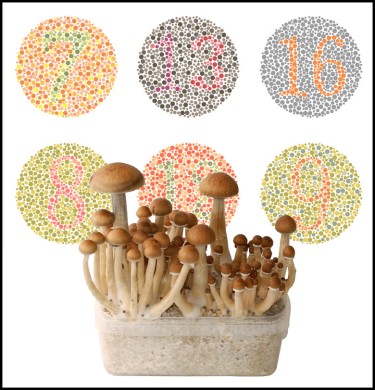
Around 300 million people in the world live with some kind of color vision deficiency.
But being color blind doesn’t mean that one is completely unable to see color. It usually means that people have a difficult time telling the difference between red, green, and yellow. However, there are also some people that can’t see any color at all – just black and white. Unfortunately, being color blind is genetic, and if one is born with it, there’s no known way to manage it.
Currently, no cure or treatment is known for color blindness.
But could psychedelics be the key to treating color vision deficiencies?
A 2021 report that was published in Drug Science, Policy and Law revealed that there are some people who consumed psychedelics recreationally. Afterwards, they were able to see colors they were never able to in the past. There were also some people who reported improvements in vision even if it has been a long time since they consumed psychedelics.
JEC Anthony and other researchers at the University of Cambridge sought out to understand if psychedelics could indeed impact color blindness. They analyzed data from the 2017 Global Drugs Survey, a large-scale study that takes place yearly, asking color-blind people if they noticed any changes in their vision after consuming psychedelics.
Among a cohort of 47 respondents who had a color vision dependency, 23 reported that they indeed experienced improvements with color blindness after psychedelics consumption. Meanwhile, the other half didn’t. But among those who experienced improvements in vision, they said that it occurred 3 days, while some experienced it for as long as years after they took psychedelics.
The researchers attribute these improvements to the ability of psychedelics to activate the 5-HT2A serotonin receptor which is responsible for neural plasticity, helping the brain create new connections.
“Psychedelics may facilitate the experience of an expanded spectrum of colors,” said the researchers. “In the excited psychedelic state, new communication between cortical regions may link new photisms to pre-existing concepts of colors, thus facilitating a new color experience and improving color blindness,” they wrote.
While there are only a few modern studies surrounding the impact of psychedelics on color blindness, it’s interesting to say the least. But one of the earlier studies was conducted in 1963 by Dr. Alex E. Krill, who published a report called, “Effects of a Hallucinogenic Agent in Totally Blind Subjects,” discussing a trial in which 24 completely blind people were given LSD in order to get them to experience hallucinations through the experiment.
“Such phenomena (hallucinations) occurred only in blind subjects who reported prior visual activity…” they wrote.
The Impact of Psychedelics on the Brain and Vision
There is still a lot we don’t know about how drugs alter our vision by its mechanisms within the brain.
For LSD, some research suggests that its psychedelic effects happen when the drug changes communication within the brain at the neuronal level. Researchers found that LSD hooks onto serotonin receptors, which is one of the vital neurotransmitters that we use for communicating. When we experience visual hallucinations on LSD, it’s likely because these receptors are stimulated within the visual cortex, a region in the brain that processes visual cues including color and light.
A study in 2016 analyzed the effects of LSD on the brain. The results, which were published in the Proceedings of the National Academy of Sciences, revealed that when people consumed LSD, their visual cortex showed unusual activity. In fact, they found bigger synchronous activity with other parts of the brain, which they attribute to the visual hallucinations the participants experienced.
Normally, our eyes process information in the visual cortex which is located behind the head. What was interesting was that under the influence of LSD, other parts of the brain worked to process visual information.
According to Dr. Robin Carhart-Harris, from the Imperial College London’s Department of Medicine and the study’s lead author: “We observed brain changes under LSD that suggested our volunteers were ‘seeing with their eyes shut’ – albeit they were seeing things from their imagination rather than from the outside world. We saw that many more areas of the brain than normal were contributing to visual processing under LSD – even though the volunteers’ eyes were closed. Furthermore, the size of this effect correlated with volunteers’ ratings of complex, dreamlike visions.”
There’s Still More We Need To Know
No doubt, we need much more research into psychedelics. If the little studies we have so far shows promising results in its ability to potentially help some people correct their color blindness and vision, that should be foundation enough to conduct more research.
It’s clear how powerful psychedelics are, and we are only barely starting to scratch the surface. The impact of these amazing drugs on the brain, so it’s no wonder that they are commonly referred to as mind-altering substances. One of the findings that consistently keeps showing up is the ability of psychedelics to alter neural pathways and connectivity in the brain, particularly in the prefrontal cortex (responsible for regulating emotions and high level cognitive function) as well as the amygdala (responsible for emotional responses).
Regardless, countless people around the world can benefit from the ways psychedelics can help rewire the brain and even influence the immune system in the brain as a whole. Remarkable evidence keeps showing up year after year. We only hope that more scientists look into a possible solution to help those with color vision dependencies in the same way people are investing into its ability to treat depression, PTSD, and other emotional disorders.