The Curious Case of Delta-8 THC

The Curious Case of Delta-8 THC

[ad_1]

synthetic cannabis banned

Should States Ban Synthetic Cannabis?


Starting July 1, 2022, Oregon became the first state to ever ban synthetic cannabinoids from retailers and grocery stores.


According to regulators, sales of synthetic cannabinoids have been banned due to rising concerns regarding the dangerous chemicals used in these harmful products. To make these products, manufacturers isolate them or make them synthetically through a lab. While they don’t contain THC, most synthetic cannabinoid products are wildly unregulated.


Synthetically made cannabinoids have made headlines due to the numerous dangerous, if not nearly fatal, intoxications that they cause. Delta-8 THC, in particular, has been on the radar of the Centers for Disease Control due to over 100 hospitalizations in half a year. But Delta-8 THC, as well as other cannabinoids that are made synthetically such as CBN and CBD, already exist naturally in the cannabis plant though in such tiny amounts that a laboratory process is needed to make more of it.


According to Christopher Hudalla, ProVerde Labs’ chief scientific officer, there are a lot of serious health and safety risks associated with making synthetic cannabinoids. “It’s very easy to do in your garage,” he told Analytical Cannabis last year. “CBD is almost free. There’s so much oversupply of CBD that it’s very, very inexpensive. It used to be something like 12 cents a milligram. Now I can buy it for probably 0.1 cents a milligram,” he said. “And you can take that and, in your garage, convert it to delta-8. So there’s very good margins in it.”


“There’s no regulatory control,” Hudalla adds. “And so we know children are consuming these products without any indication about how safe they are. That’s hugely irresponsible in my opinion.”


How Did We Get Here?


It was sometime back in the mid-2000s that synthetic cannabis products started to appear in gasoline station shops and convenience stores. They were also known as Spice and K2, made from substances that weren’t specifically banned by federal or state laws. However, once we reached the end of the decade, many states have already banned their sale.


In 2012, President Obama enacted the Synthetic Drug Abuse Prevention Act. This was helpful in making numerous synthetic cannabinoids highly restricted under the Schedule 1 classification – unfortunately, the same classification that real marijuana is on at the moment.

Oregon is the very first state to ban the sale of laboratory-grown marijuana, but at least 43 other states have already placed restrictions of some sort on synthetic cannabinoids. However, I believe that all states should follow suit with Oregon because this highly unregulated product is a serious risk to society. Even though the FDA doesn’t regulate the medical marijuana industry, a strict (and expensive!) licensing process is required for individuals or businesses to establish dispensaries. In addition, there is a huge difference from synthetic cannabinoids and the legal marijuana industry because states set their own regulations about cannabis, and educated consumers know to look for established brands. A certificate of analysis is also provided by some brands for consumers who want peace of mind about what truly goes into every product they put into their body.


Marijuana is cultivated primarily for its therapeutic purposes, similar to its CBD-rich cousin – hemp – which is cultivated for other uses too such as its use in textiles and even concrete substitutes. On the other hand, synthetic cannabinoids, it seems, only merely seeks to mimic the impact of marijuana. That’s why it’s so appealing to those who don’t know better – such as teenagers, who also don’t have the budget to buy from dispensaries. And because of this, there is such a big risk allowing synthetic cannabinoid manufacturers operate in the market.


There needs to be some kind of regulatory framework at the very least so that we can prevent its harms.   Back in the day, Spice and K2 were sold as marijuana though one sniff or touch of the stuff and you can already tell that it isn’t the real deal. But these days, synthetic cannabis is already being infused into gummies, after which there’s no way to tell the difference.


Delta-8 THC products are flourishing in the market nowadays, too, but one has to tread with caution, no matter how much of a seasoned cannabis consumer you think you are. According to the FDA, there were 104 cases of adverse reports among people who consumed delta-8 THC from December 2020 through February 2022. Fifty-five percent of them needed medical intervention, such as through hospitalization or emergency medical services while 66% reported adverse effects after consuming delta-8 THC edibles. The adverse effects included vomiting, anxiety, tremors, loss of consciousness, and hallucinations to name a few.


It also puts the real thing in a bad light.


In 2019, the American Association of Poison Control Centers stated that CBD was considered an “emerging hazard” because of cases involving contamination and mislabeling, according to a CNBC report.


At the end of the day, it’s up to states to make use of the necessary prosecution methods and administration actions to ban these substances and sales entirely. While regulating them could help in a way, but all the bad news of the dangers simply outweigh the benefits, and simply put, when the real marijuana is out there, why do people need to succumb to the fake stuff anyway?


Sure, it’s much cheaper to make synthetic cannabis – but is your health worth the risk? Going into a coma, being hospitalized, and feeling like you’re going to die? These are things that cannabis will never do to you.


So it’s up to the states to ban them. And it’s high time all states should follow in the footsteps of Oregon.


THE DELTA-8 DEBATE, READ MORE…
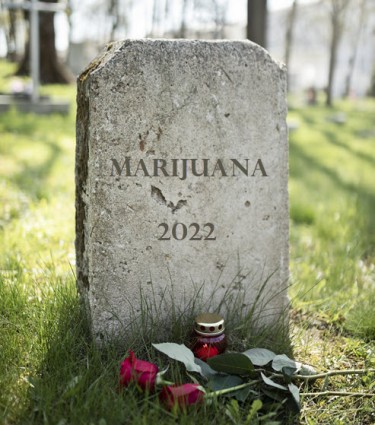
MARIJUANA IS DEAD, THE CASE OF DELTA-8

THE MARIJUANA INDUSTRY IS DEAD – THE CASE OF HEMP DELTA-8

[ad_2]

Source link

California City to Charge Separate Violations Per Illegal Plant

[ad_1]

Brentwood, California officials are fed up with the uptick in home cultivation violations and did something about it.

On July 12, the Brentwood City Council intensified the rules on the home cultivation of cannabis—taking the rules beyond the legal six-plant limit inside a personal residence. Administrative citations may be issued—per plant—for any plants that are grown beyond the legal limit.

The measure was approved by the Brentwood City Council by a 4-0 vote, with Vice Mayor Johnny Rodriguez absent.

Residents should be careful about considering how many plants to grow at home. A $100 citation will be issued for the first violation, $200 for the second violation, and $500 for the third and subsequent violation. What it means is that now each plant will be considered a separate violation.

According to Code Enforcement Supervisor Roberta Portillo-Bienemann, the city has seen an uptick in cannabis cultivation violations. The new rules would give code enforcement agents additional tools to fight illegal home cultivation, putting a bit more pressure on residents who are considering defying the rules.

Typical illegal grow operations have up to 10 violations, Portillo-Bienemann said, but the new rules would add more violations, depending on the number of plants that are found by code enforcement.

Portillo-Bienemann said it usually gives the offender five to seven days to appeal the citation, however the city could issue fines per plant, per day.

“In order to give an individual their due process, right, and their ability to appeal that citation, if they choose to do so, we issue the administrative fines on a weekly basis,” she told the Santa Cruz Sentinel. “It is hoped these revisions will increase the city’s code enforcement capabilities and deter illegal marijuana cultivation.’’

But next door in Antioch, California, the police say there’s no actual problem taking place—at least not in their city.

Antioch Interim Police Chief Steve Ford said that in his city, they haven’t seen any grow houses in the last year, however at least one illegal warehouse grow operation was discovered months ago and punished by code enforcement.

“As crazy as it sounds, I’d like to think that that [the availability of dispensaries] has helped to mitigate the need for people to want to try and erect a weed house or weed grow because they don’t have to do that,” Ford told the Santa Cruz Sentinel.

Brentwood has regulated home cultivation since 2017, when it incorporated California law into its municipal code to reflect Proposition 64. City leaders are mostly worried about large-scale operations, and they say that the crop sizes reach the hundreds or thousands, and they believe it creates health and safety risks.

Brentwood Mayor Joel Bryant said he supported the new home cultivation rules.

“Having seen some of these grow houses in our community, not only is there immediate danger to the neighboring houses of fire and there are health concerns from the mold, but there also have been some violent interactions from criminal activity,” Bryant stated. “Not only from the growers but people that are criminals that found out that that grow house was there.”

Councilwoman Susannah Meyer approved the measure, saying that the enhanced rules don’t impede anyone’s rights to consume cannabis.

Some residents also agreed with the enhanced violations, saying that the issue is about protecting their property values.

Assuming you’re staying within the legal limit in your respective city, and assuming your state allows it, High Times provides guidelines, focusing on the ins and outs of growing cannabis at home.

[ad_2]

Source link

Headset Report Analyzes Turnover Rates for Budtenders in the U.S. and Canada

[ad_1]

The cannabis data collection company Headset released its latest report on July 13, which covers budtender/employee turnover rates in cannabis dispensaries.

Headset calls cannabis budtenders the “heart and soul of the industry,” because they are essentially ambassadors for the plant and the industry. “Because of their extreme importance, budtender hiring, onboarding, and management is one of the most crucial tasks in any cannabis retail operation,” Headset writes in its introduction. “One of the great challenges of managing budtenders, or staff in any business, is employee turnover. Turnover is often unavoidable and always costly, so it’s essential to optimize the employee hiring and managing process wherever possible. In this report, we explore budtender turnover in the US and Canada to get an understanding of what is and isn’t normal when it comes to budtender turnover.”

The report analyzes information collected between June 2021 through May 2022, with a search in Arizona, California, Colorado, Illinois, Massachusetts, Michigan, Nevada, Oregon and Washington state, as well as the Canadian provinces of Alberta, Ontario, British Columbia, and Saskatchewan.

For both the U.S. and Canada, the split between senior employees and new employees is nearly the same. In the U.S., 40.6% are employees that were hired more than 12 months ago, with 59.4% being considered as new hires. In Canada, the split between 12 month employees and new hires is 40.1% and 59.9% respectively.

The percentages begin to differ when reviewing the percentages of employees who stay at cannabis dispensaries versus those who leave before the 12-month mark. In the U.S., 45.4% continued working after one year, but 54.6% left, and in Canada, 43.6% stay on while 56.4% quit.

Further data shows that ~16% of employees in both the U.S. and Canada continued to work at their job, but only ~24% chose to leave. The percentage in relation to new hires choosing to stay or leave is much higher—29.3% and 30.1% in the U.S. 27.3% and 32.5% in Canada.

There are many reasons that could influence budtenders to leave their jobs, and in most cases the data is similar in the markets used for analysis. “Retailers in Illinois, for example, seem to be better than average at retaining more experienced staff members for more than one year with 55% of employees hired more than one year ago,” the report states. “Conversely, retailers in Colorado and Oregon tend to have far lower retention, both with more than a third of budtenders starting and ending their employment in the past 12 months. In Canada, Alberta is a bit of an enigma with retailers tending to have slightly better retention among new employees but having lost a larger amount of more tenured employees than in other Canadian provinces.”

The report also shares that 23% of new hires in the U.S. and 24% in Canada leave before the first 30 days of their employment, which is likely attributed to an “efficient and effect new hire onboarding process.”

However, those who perform well in sales are more likely to continue working. “The better performing the budtender is, the more likely they are to continue working,” Headset concludes. “This could be simply because it feels good to do well at a job and so it’s natural to want to continue. However, budtending is still a tip-driven position in many markets and being a top performer could also mean an employee might be bringing home more total income than his or her coworkers.”

[ad_2]

Source link

Brittney Griner’s Lawyers Tell Russian Court She Has Doctor’s Recommendation for Medical Cannabis

[ad_1]

Brittney Griner’s trial on cannabis possession charges continued in Russia on Friday, with the WNBA star’s attorneys telling the court that she has a doctor’s recommendation to use medical pot. Griner was arrested at an airport near Moscow in February after customs agents reportedly found vape cartridges containing less than one gram of cannabis oil in her luggage as she made her way through a security checkpoint. If convicted, she faces up to 10 years in prison.

At a hearing on Friday, her defense team submitted evidence that could elicit leniency from the court, including documentation that she has a doctor’s recommendation to use medical cannabis in the United States. The defense also submitted evidence that Griner had recently passed an anti-doping drug screening, with no prohibited substances found in her system.

“The defense today provided written evidence, including character materials, medical documents and tax returns,” Griner’s lawyer, Maria Blagovolina, told Reuters.

“Among the medical documents is a doctor’s note for the substance that Brittney Griner inadvertently left among her belongings when crossing the border,” she said.

Griner’s lawyers also noted that the recommendation to use cannabis medicinally had been sanctioned by the state government in Arizona, where she is the star center for the WNBA’s Phoenix Mercury.

“The attending physician gave Brittney recommendations for the use of medical cannabis,” Blagovolina added. “The permission was issued on behalf of the Arizona Department of Health.”

Griner’s Plea

Griner’s trial began on July 1 in a courtroom in Khimki, a suburb of Moscow where the airport is located. She pleaded guilty on July 7 to the charges she faces, although she told the court that she did not intend to commit a crime and that she had packed for her trip quickly, unaware that the vape cartridges were in her luggage. While Griner has already pleaded guilty, her trial continues as the court considers the circumstances of the alleged offense.

In a statement after Griner entered her plea, her legal team said that it was the WNBA star’s decision to plead guilty to the charges, adding that the move “sets an example of being brave.”

“She decided to take full responsibility for her actions as she knows that she is a role model for many people,” the attorneys said. “Considering the nature of her case, the insignificant amount of the substance and BG’s personality and history of positive contributions to global and Russian sport, the defense hopes that the plea will be considered by the court as a mitigating factor and there will be no severe sentence.”

On Thursday, some of Griner’s teammates on the Russian basketball team she plays for, UMMC Ekaterinburg, addressed the court as character witnesses. Team captain Evgeniya Belyakova told the court that Griner is “the heart of our team,” according to a tweet from Moscow NPR correspondent Charles Maynes, and said that fans in Russia “adore her.”

After the hearing, Griner’s attorneys said that UMMC Ekaterinburg director Maxim Ryabkov “gave a positive description of Brittney Griner during his speech in court, noting her outstanding abilities as a player and personal contribution to strengthening the team spirit, which allowed the team to achieve the highest results in the Russian basketball premier league and in international competitions for many years.”

Griner ‘Wrongfully Detained’

The U.S. State Department has officially listed Griner as wrongfully detained and the White House has said that President Joe Biden is doing everything he can to secure her release from Russia. Media reports have speculated that the governments of the United States and Russia could eventually engineer a swap of prisoners, with the American authorities perhaps releasing Russian arms trader Viktor Bout, nicknamed “the Merchant of Death,” who is serving a 25-year sentence for conspiracy to kill U.S. citizens and providing assistance to a terrorist organization.

After Friday’s hearing, U.S. Embassy charge d’affaires Elizabeth Rood commented on the support Griner has received during her trial.

“In the hearings yesterday and today what became very clear is the tremendous amount of respect and admiration both in the United States and here in Russia where Miss Griner has been playing basketball for seven years, not only for her professional achievements but for her character and integrity,” she said outside the courthouse.

Deputy Foreign Minister Sergei Ryabkov, the senior Russian diplomat, has declined to comment on a potential prisoner swap, noting that until her trial concludes “there are no formal or procedural reasons to talk about any further steps.”

Ryabkov also warned that criticism from the United States, including Griner’s status as wrongfully detained and negative comments about the Russian court system, “makes it difficult to engage in detailed discussion of any possible exchanges.”

The next hearing in Griner’s trial is scheduled for July 26. Her legal team has said that they expect the trial to conclude sometime in August, although her detention has been extended until December 20 by Russian authorities.


[ad_2]

Source link

Is Cannabis Shaming a Real Thing?

Is Cannabis Shaming a Real Thing?

[ad_1]

cannabis shaming

How this one post about a cannabis conference revealed what’s wrong with the world today

https://www.reddit.com/r/fatlogic/comments/vrdlk8/cannabis_conference_fatphobic_because_of_the_the/


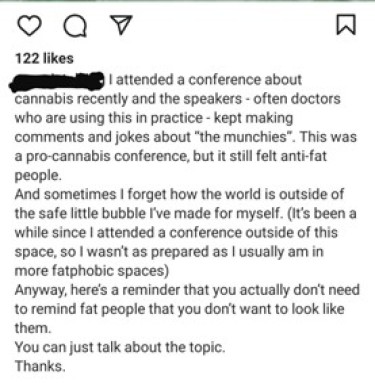
A recent Reddit Post illustrated a comment on the “Fatphobic” nature of cannabis conferences due to the mentioning of munchies. The question then being, is talking about eating shaming fat people?


For context, prior to engaging in the rest of the article, I’ll post the original screen shot of the comment here;

cannabis shaming

As you can see here, the person in question was attending a conference and found that talking about “the munchies” was a direct assault on fat people.


We would have to assume that the original poster of this comment must be overweight and as a result feels some sort of shame for their current bodily configuration.


However, this is all fine but there was a particular phrase within the comment that revealed a deeper revelation about what’s happening in the world. It was the phrase, “And sometimes I forget how the world outside of the safe little bubble I’ve made for myself. (It’s been a while since I attended a conference outside of this space, so I wasn’t prepared as I usually am in more fatphobic spaces).


This right here – in my opinion – is one of the major reasons we are seeing this cultural clash play out in the public space. This brings us to a matter of subjectivity, the imposition of self on others, and whether or not the world should bend to suit your personal narratives.


So why don’t you go ahead and grab a joint or a bong, sit back and explore these concepts with me.


Why Personal Bubbles Pop!


Let’s tackle this very first aspect of the comment, “the safe little constructed bubble”. While having a “safe space” in theory seems like a good idea, the fact of the matter is that nowhere is empirically safe. Safe is a subjective concept meaning that what you consider “safe” is not necessarily “safe” for someone else.


A “safe space” in essence is a place where you can freely express yourself without the fear of retaliation from others. In other words, it’s a place where “YOU” are always right and nobody else can say anything to disrupt this.


While it’s good to nurture your own self-worth and dialogue with your unconscious self regularly, there has to be a sense of objectivity to your actions. Think of it this way, when your world is subjectively constructed around your personal narrative, and the external world doesn’t reflect this idealized version of reality – whenever the “consensus reality” crashes into your bubble…it pops!


Suddenly, you’re exposed, outnumbered and vulnerable. How you can feel “safe” now that counter-narratives invaded your space. How can you “unhear” these narratives?


The truth of the matter is that you can’t un-hear these narratives. You can either redirect or reconstruct the narrative to suit your own, accept it as part of the consensus reality, or try to fight it in order to have the world bend to your will.


Often times, people who subscribe to the idea of a “safe space” would go on the offensive, trying to change the world’s perspective on their subjective experience of it. This often backfires and swings the pendulum further away from their truth.


But why does it matter? Why is it necessary for some to completely snuff out the narrative of the other? I believe it’s because the counter-narrative illuminates the shaky foundations of their internalized and sustained belief.


They can detect hints of truth within the counter-argument, which in turn creates a sense of “inauthenticity” in their lives. If their current actions that are attributing to their internalized problems, are also a part of the reason they are suffering – they choose to blatantly ignore these elements in order to repair their damaged internal image.


In the case of the OP, calling “talking about the munchies” as Fatphobic, is to say assert that “eating is not the reason why some people get fat”. When in reality, we know that exercise, a proper diet, and a well-balanced psychology all form part of weight retention.


To ignore this fact is to make oneself willfully ignorant to their own problems. It also means that if anyone hints at this truth that it would be interpreted as a direct assault to the person holding these views.


In turn, they isolate themselves further into their “Safe Spaces”, finding people who hold similar views and building up a “world view” according to their niche community.


Unfortunately, even within communal disillusionment, consensus reality will inevitably pop those bubbles en-masse.


Why it’s better to become comfortable in “unsafe spaces!”


We essentially want a “safe space” in order for us to sleep, rest, heal, and be ourselves. This is the purpose of an environment of this nature. This is why we have homes, bedrooms, etc. However, you don’t live solely in these spaces and never venture out into the world for a fear of “something bad” happening to you.


Well – some people do, but they typically have psychological condition that amplifies their discomfort and perceived hostility of their environment.


Ironically, it’s during these hard times that a safe space can provide a temporary platform so you can heal, but you cannot outsource this safe space into the world.


The “world” by definition is a hostile place where everything is heading towards chaos – everything is in a state of Entropy.


This reveals to us two major truths;


  1. Your safe bubble is a space that remains stagnant in a world that is in constant evolution

  2. What you found hostile before might have evolved with the time, the culture, etc.


What this means is that as long as you remain in your “safe space” the world outside continues to evolve and change. The moment you feel “protected” against the old narrative, you find that in the time you excluded yourself from the global conversation that you now face multiple new narratives – once more challenging your original position.


It’s far better to become mindful of your problems and to learn how to be okay while you’re in a difficult spot. To address the root cause of your unhappiness and why this particular idea is triggering you so much.


Perhaps, in the case of the overweight individual – if diet is such an important element to eating, it would return the responsibility of weight back onto the individual. It would mean that being fat is a choice and it would cost “effort” to change this. Effort the individual isn’t willing to pay.


Perhaps it also reveals a deeper underlying issue – their addiction to the food.


However, if you want to “stop feeling” bad for these narratives – it’s probably best to:


  1. Truly analyze the source of your problems, identify if there’s anything YOU can do

  2. Learn to Love yourself through the discomfort

  3. Make the appropriate changes if you are unhappy with your current situation


These are the most effective ways to deal with any kind of problem.


But…but…but…cue the excuses!


The moment when the responsibility is shifted back to the individual is the moment the excuse monster wakes up. It begins finding all the reasons why you can’t do X, Y or Z.


“I’m poor and can’t possibly!”

“I’m overweight because of genes!”

“I can’t get ahead in life because of ____(fill in the blank)”


This in essence is the victimization of self and removes all responsibility and power away from the individual. I’m not saying there aren’t factors that make it “harder” for some than for others.


For example, it’s far more difficult if you are overweight to start working out than if you are fit and on your ideal weight. This is because over time, you form habits and a certain type of gravity towards particular actions and non-actions.


There’s a momentum in your life.


Breaking this momentum requires effort, changing directions of the momentum even more – but with enough persistence, you can create a new direction and momentum towards what you truly want in life.


This is all a part of the Great Cosmic Automation and when you understand this, you can shape your habits to lead towards your ideal life as opposed to being subjected to the power of your current internal automation.


The book “Atomic Habits” talk about this in great detail.


Your excuses or “reasons” for why you can’t will always be the factor that stands between you and the happiness or acceptance you desire. And if you’re making a safe space to hide in, where the world can’t dialogue with you and where you can’t update your own internalizations according to the “global script” – then you’ll become a victim even when a comment isn’t directed towards yourself.


May this post put a mirror to our own justifications


The person in the post that felt the aggression from the speakers at that cannabis convention is a more extreme example of what we all do in various situations. We believe that the world needs to behave our criteria when in reality, the world gives zero fucks about any one of our personal belief systems.


There will always be people who hate you for a wide number of reasons, others that will love you for the same. At the end of the day, none of that matters except how you feel about yourself. If you need other people to affirm your identity then it means that you’re not living your authentic self.


You are merely a forgery of what you could be, and you’re either too afraid or too lazy to make the right changes to invoke your best self. Nonetheless, this is something that applies to us all…so instead of shitting on the victim of self-induced fat-shaming, let’s look at ourselves and make better choices.


Pop your safe space bubble and step into the real world. It’s not as bad as you think!


CANNABIS AND THE MUNCHIES, READ THIS…

WHY DOES CANNABIS CAUSE THE MUNCHIES

CANNABIS AND THE MUNCHIES, WHY DOES IT ALWAYS HAPPEN?

[ad_2]

Source link

Wee-Delivery Chatbox
!

Wee-Delivery Assistant

How can I help you?

Hi there! 👋 Welcome to Wee-Delivery. How can I assist you today?
Call us: 888-422-9658
Hours: Mon-Fri 9am-1pm, closed 2pm-6pm, then open until 11pm. Saturday 9am-11pm, Sunday by appointment.
Delivery minimum
Are you open now?
Service areas
Verification process
Payment methods
After hours
How to order
Call 888-422-9658